 Canada (EN)


Change is forever a constant for the workforce. A steady cadence of products, services, processes and technology creates a vibrant, exciting environment that spurs innovation, productivity and growth. Yet in this continuous cycle of transformation, we’re poised to take a leap forward that could truly change work in ways we can’t yet imagine, with the ushering in of the Artificial Intelligence (AI) revolution.

Granted, AI isn’t new. Its origins date back to 1950, when English mathematician and computer scientist Alan Turing published a seminal paper titled “Computing Machinery and Intelligence.” Seeking to answer the question, “Can machines think?” Turing posited there is no convincing argument that machines cannot think intelligently like humans and different approaches should be undertaken with the goal of advancing machine intelligence.
Fast forward 75 years and AI is very much present — both at work and at home.
At first, employees weren’t sure what to make of this groundbreaking new technology. Suspicion, reluctance to see its usefulness and mistrust in its capabilities, all fueled by sometimes dystopian media reports, held many workers back from buying into the hype. Yet, with increased exposure and usage, we’re seeing a growing acceptance of the technology and enthusiasm about working with it.
Replacing apprehension with anticipation
The 2025 Alight Employee Mindset Study found employees are becoming increasingly comfortable with generative AI tools, and most now believe AI will fundamentally change the way they work, a number that increased five percentage points since last year. Additionally, the percentage of workers who say their employer encourages the use of AI has increased from 35% to 41%. This encouragement has translated to more usage, with nearly three-quarters of employees reporting AI use at work, up from two-thirds in 2024.
As AI continues to reshape the workplace, employees’ attitudes reflect a mix of optimism and apprehension about its potential effect on their careers. While 43% of employees now see AI as a tool that makes their job easier, concerns remain about its impact. Specifically, 39% admit AI scares them and one-third are concerned it may replace them in their jobs. But with a growing number of employers encouraging AI usage at work (41%, up six points year-over-year), 45% of employees believe they will fall behind if they don’t learn how to use it.
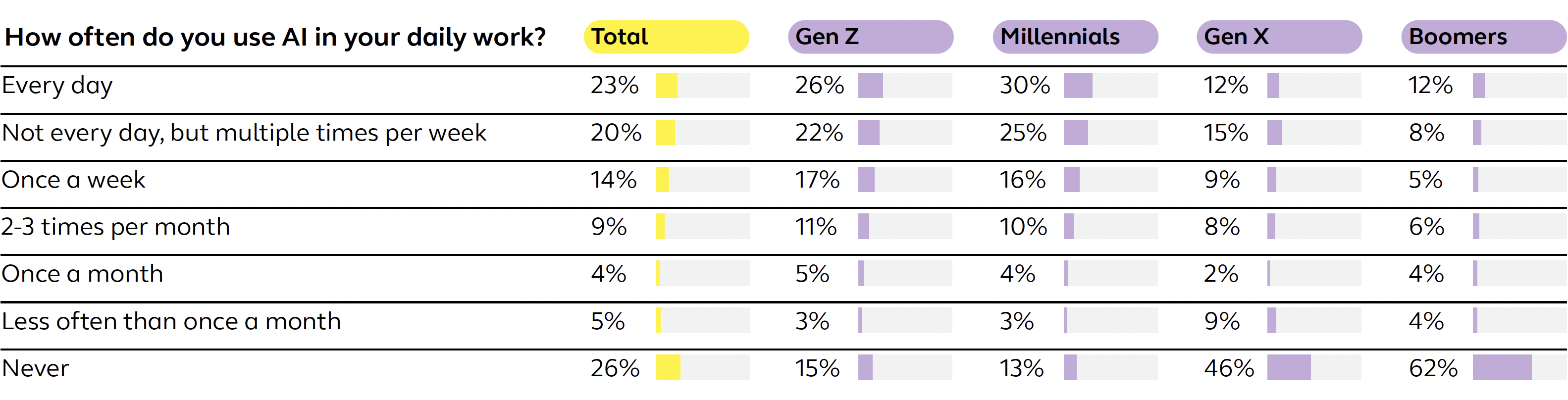
However, AI usage varies significantly across generations. Millennials and Gen Z are much more likely to use AI at work, with only 15% and 13%, respectively, saying they never use it. By contrast, 62% of Baby Boomers report never using AI at work. Bringing employees along on your AI journey may require a different approach for older workers to help them become more comfortable.
Despite differences in AI adoption across generations, workers’ emotional response to AI reveals a surprising consistency. When asked if AI scares them, nearly 40% agree across all ages, while just under a third disagree, and the remainder are neutral. Moreover, AI anxiety is closely tied to job security concerns: half of workers scared by AI worry about their job stability, compared to just 25% of those not scared by AI.
This anxiety translates into a more negative outlook on work. Employees scared by AI are more likely to dread starting their workday than those who don’t fear the technology (56% vs. 23%). These findings suggest that AI-related anxiety can have far-reaching consequences for worker wellbeing and job satisfaction.
The personal side of AI
When asked for their current feelings about AI, employees’ top two answers continue to be positive — hopeful (36%) and excited (34%). We see that same optimism shine through when employees are asked if they trust AI to make good recommendations, with 43% agreeing compared to only 36% in 2024. And people are less skeptical of the output, with only 42% in that camp.

This is critical as employers lean into the use of AI not just in the workplace but in the benefits and HR space as well. The good news is that with AI becoming more prevalent, employees’ willingness to share personal data with their employers has also increased. Since 2023, there has been a rise in the percentage of workers who feel comfortable sharing personal data in exchange for more tailored guidance.
More than three-quarters (77%) now say they are comfortable sharing health information, up from 69% in 2023, while 73% are comfortable sharing financial information, up from 65% in 2023. Similar numbers of employees are interested in receiving personalized messaging from their employer around benefits and programs based on their personal health and financial information. Unfortunately, only 23% report that either type was available to them.

People want the relevant support that AI can provide, and they are increasingly open to getting it. The value they see in it can influence their perception of the benefits and rewards an organization offers. What’s more, those with a high benefits understanding are twice as likely to trust AI to make good recommendations. This growing comfort with data sharing may help ease skepticism and unlock the full potential of AI in the workplace.
Creating a culture of AI
Clearly, it’s in the employer’s best interest to improve employees’ comfort level with AI. The key lies in not only providing them with the tools and technology, but in investing equal amounts of energy and effort into building a culture of AI. This extends beyond just offering AI tools. As with any type of support, it is incumbent to promote those tools and offer training to help employees use the tools effectively. Then, it’s making sure that from a culture perspective, there is personal accountability, community support and the opportunity to share their AI successes with others. As employees put AI tools into practice — and see others doing the same — they will feel empowered, rather than fearful.

The company’s messaging around AI is critically important. Organizations need to inspire and engage employees, but they also need to be careful of overpromising or drawing lines in the sand, as the AI environment is constantly evolving and shifting. Employees need to hear they are being brought along on the AI journey, rather than feeling like something is being forced upon them. Messaging must include how AI is going to affect the organization’s long-term growth by enabling more efficiency and greater productivity as employees are freed up to focus on higher value work. While lingering anxiety and apprehension remain, particularly around job security, such messaging will help people feel hopeful and excited about AI, instead of doubtful and scared.
Companies can’t take a wait-and-see approach to AI. It’s only going to continue growing in prevalence and importance — and those who bury their heads in the AI sand will be left in the dust. While there’s still progress to be made in getting employees comfortable and confident working with AI, the good news is there is an increasing acceptance of the technology, as more workers become exposed, trained and experienced in its usefulness.


